
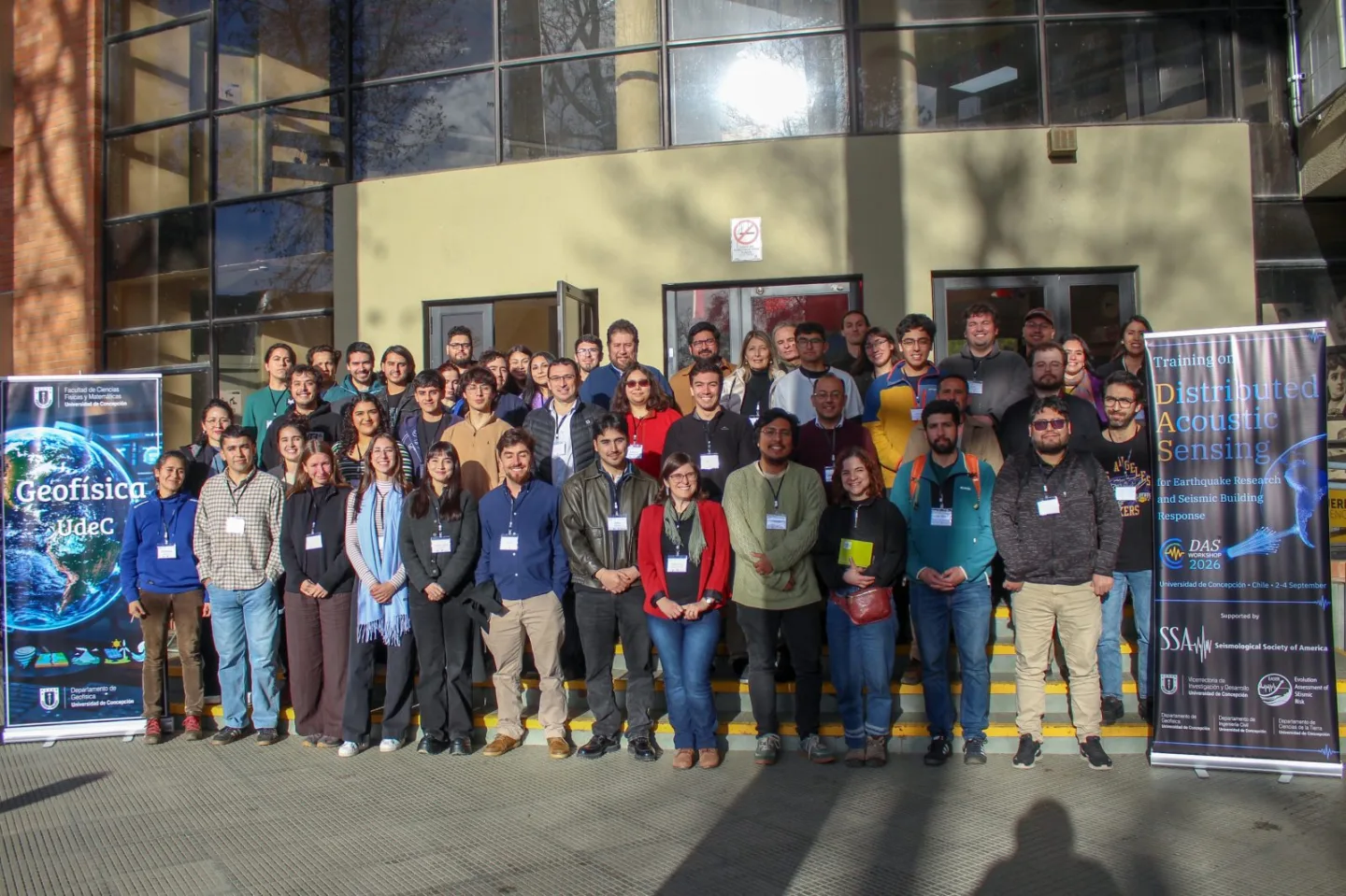
Four members of the Millennium Institute of Oceanography attended the DAS Workshop Concepción 2026, where they explored and tested a technology that transforms optical fiber cables into sensors capable of detecting earthquakes, volcanic eruptions, and other geophysical processes.
From September 2 to 4, four members of the Millennium Institute of Oceanography (IMO in spanish) took part in the Distributed Acoustic Sensing (DAS) Workshop Concepción 2026. This key training session focused on DAS technology, which enables optical fiber to record vibrations, seismic signals, and ocean waves.
Held at the Faculty of Physical and Mathematical Sciences of the Universidad de Concepción (UdeC), the workshop was attended by IMO team members Edwin Rodríguez, Vera Oerder, Darinka Pecarevic and Andrea Sepúlveda.
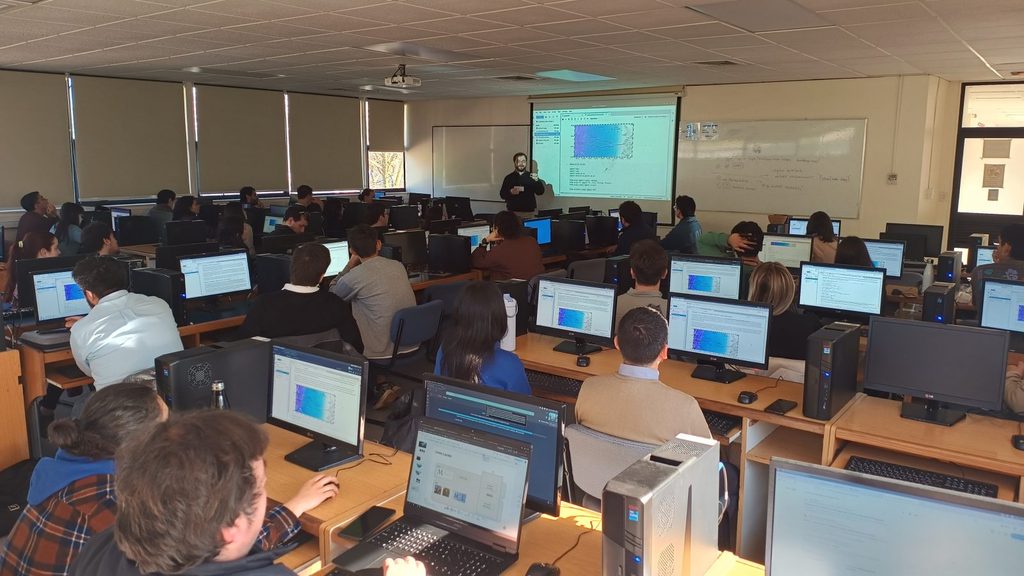
Alongside students and researchers from across the country, participants covered the full DAS workflow: theoretical foundations, field deployment of fiber optics, and data analysis using open-source tools and machine learning.
The workshop was organized by UdeC faculty members Catalina Morales-Yáñez and Javier Ojeda, together with international experts Ethan Williams (University of California, Santa Cruz) and Ettore Biondi (Stanford University).
A Technology with Oceanographic Potential
For Darinka Pecarevic, Technical Specialist at the IMO, the experience was particularly eye-opening in demonstrating the international scope of DAS applications. "It was very novel, bringing together people who were just beginning to understand the scientific applications of this technology. While I was already aware of what could be achieved with DAS, discovering the level of detail and application it has reached in other countries—such as real-time earthquake monitoring or volcanic eruption tracking in high-risk areas—was truly revealing and motivating", she noted.
Regarding her own background and contributions, Pecarevic highlighted that "having a solid foundation in Earth Sciences allowed me to follow the concepts throughout the workshop. Certain ocean-related applications were much easier for me to grasp than for other colleagues who seemed less comfortable with the topic. In terms of data processing, when you already have background in analysis workflows, the logic is easy to understand and follow. Despite the intrinsic complexity of each section, grasping the processing and programming posed no major hurdle".
Among the key takeaways for the team was a hands-on cable installation exercise in Dichato, which holds direct relevance for the IMO’s operations. Aligning with the institute’s long-term research goal of deploying this technology to monitor the Atacama Trench, the training provided insight into the capabilities, operational precautions, and installation methods required, while offering practical methodological observations.
However, Pecarevic also cautioned that marine applications of DAS remain in their early stages. "Data analysis and processing for marine environments using this technology are still very nascent. Among the visiting experts, only one had extensive marine experience; it is a field that is truly just taking off”, she stated.