
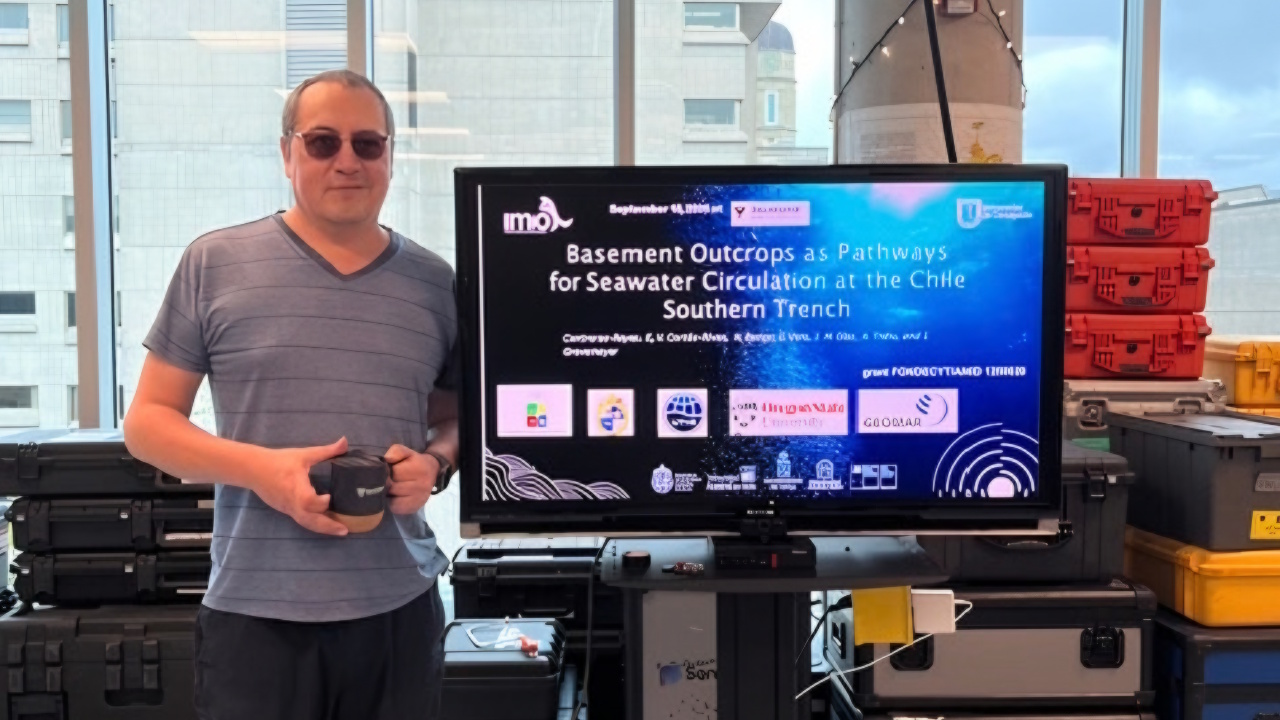
During a three-week research stay at the University of British Columbia and Dalhousie University, the scholar advanced joint initiatives in scientific instrumentation, human capital development, and research collaboration.
To strengthen international collaboration in marine geophysics, the Principal Researcher at the Millennium Institute of Oceanography (IMO in spanish) and holder of a Ph.D. in Geophysics, Eduardo Contreras-Reyescompleted an academic visit to Canada from September 1 to 21. The itinerary included visits to the University of British Columbia (UBC)in Vancouver and Dalhousie Universityin Halifax, Nova Scotia.
As part of international outreach activities, Dr. Contreras-Reyes delivered a seminar titled «Basement Outcrops as Pathways for Seawater Circulation at the Southern Chilean Trench» at Dalhousie’s Department of Earth and Environmental Sciences, presenting research conducted by the IMO in the Atacama Trench.
"The experience was highly fruitful”, noted Contreras-Reyes. In addition to the seminar, the researcher highlighted discussions regarding the donation of"a seismic source (a 9-airgun array), which is an outstanding system for investigating the Chilean subduction zone”. This equipment generates acoustic waves to map the sub-seafloor structure.
Concurrently, during his time at UBC, Contreras-Reyes reported progress on the "joint deployment of a temporary Ocean-Bottom Seismometer (OBS) network in central Chile alongside the IMO".
“At both institutions (UBC and Dalhousie), we explored future Ph.D. opportunities in marine geophysics for Chilean students within our academic community, as well as technical training programs for the IMO team”, she stated.
A Long-Term Partnership
According to the researcher, the visit consolidated a strategic partnership in marine geophysics among the IMO, UBC, and Dalhousie, combining academic exchange with operational projects.
Contreras-Reyes emphasized that the visit "not only provided an international platform for our research on the Chilean trench and margin, but also set in motion concrete mid- and long-term initiatives—such as the temporary OBS network in central Chile, the transfer of specialized instrumentation, and new pathways for advanced human capital development through doctoral studies and technical exchanges".