
Researchers from the Millennium Institute of Oceanography (IMO) attended an international symposium in Shanghai, China, held from August 27 to 29, laying the groundwork for new collaborative efforts in deep-ocean exploration.
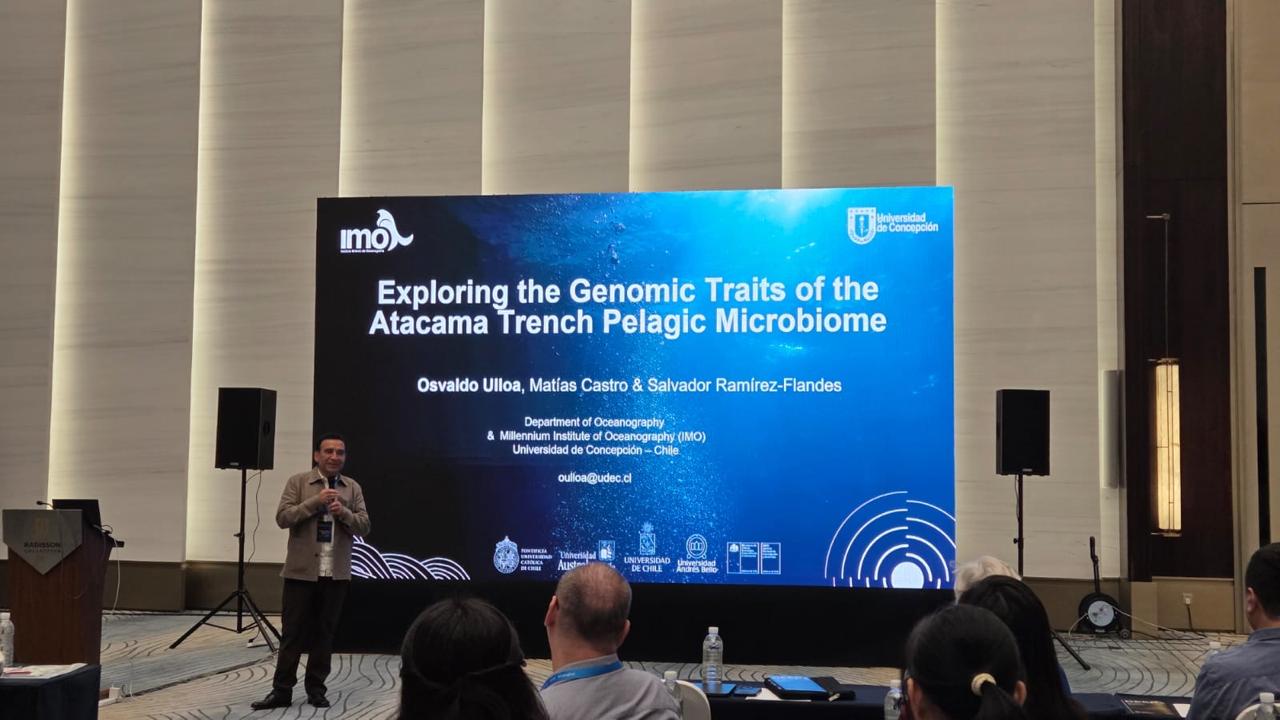
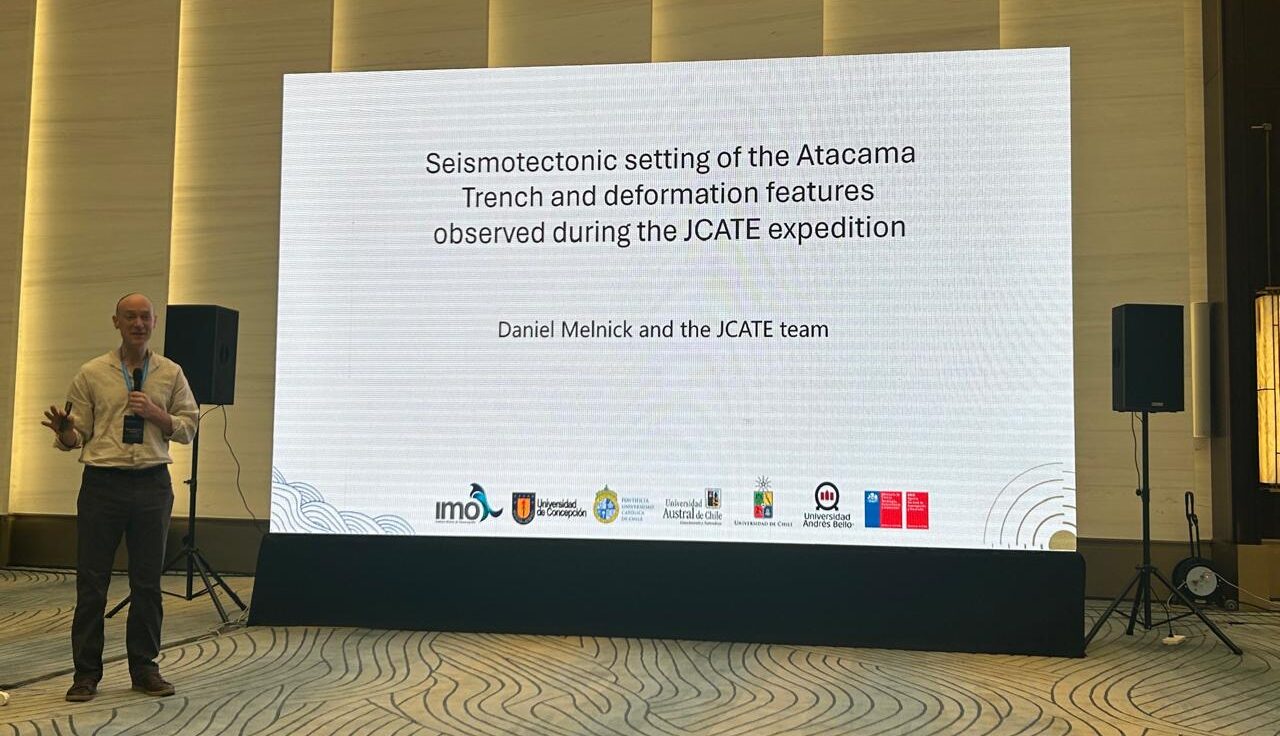
The director of the Millennium Institute of Oceanography (IMO in spanish), Osvaldo Ulloa, and the Principal Researcher, Daniel Melnick, presented findings from their research in the Atacama Trench at "The International Symposium on Deep-Sea Frontier Science", held in Shanghai, China.
The event, which took place from August 27 to 29, brought together over 100 specialists from 14 countries. It paved the way for new collaborations with research centers in China and Peru, featuring presentations spanning disciplines from deep-sea biology to advanced exploration technologies.
Dr. Osvaldo Ulloa delivered a highly positive assessment of the gathering, noting "We gained direct insight into the frontier science being conducted in the deep ocean, particularly initiatives led by researchers from China and other Asian nations. These forums for exchange are vital to consolidating international collaborative networks and projecting the IMO’s work on a global scale".
Ulloa explained that the institute’s participation aligns with its broader internationalization strategy:"Our science is global by nature; consequently, we must showcase it internationally and partner with other scientific communities to address larger-scale scientific and technological challenges together".
The IMO Director also emphasized that the invitation to the symposium was direct and that, beyond scientific presentations, “we participated in focused working sessions to discuss an international collaborative research program in hadal zones for the coming decade. Participating in these discussions and planning efforts aligns with our vision for the IMO to serve as a world leader in deep-ocean science".
Dr. Daniel Melnick highlighted that the symposium opened new avenues for collaboration while "deepening our work with colleagues from the Institute of Deep-Sea Science and Engineering (IDSSE) of the Chinese Academy of Sciences (CAS), with whom the IMO previously carried out the JCATE expedition to the Atacama Trench in February of this year.” He added, “We also received an invitation from researchers at the Marine Institute of Peru (IMARPE) to participate in an upcoming oceanographic cruise alongside IDSSE, planned for February 2027, as well as to jointly exchange and analyze data. Additionally, other researchers expressed interest in exploring future collaborations on topics aligned with the IMO’s research focus".
En el simposio también participó Paola Peñafrom the National Geology and Mining Service (SERNAGEOMIN in spanish)also participated in the symposium, adding to the growing presence of Chilean institutions in international deep-ocean research forums. "“We presented a poster showcasing preliminary petromorphological and petrographic observations from the various rock types recovered during the expedition to the Atacama Trench. In this initial phase, we examined and analyzed 38 samples collected at depths exceeding 7,000 meters across approximately 800 kilometers, enabling us to begin characterizing both the oceanic and continental plates,” she added.
Reflecting on her participation, Peña noted that the experience “allowed me to broaden my knowledge of marine sciences and explore diverse research perspectives regarding the deep ocean. The multidisciplinary nature of the symposium highlighted how various fields complement one another to foster a comprehensive understanding of the processes occurring in these environments. Furthermore, forums like this encourage collaboration, the exchange of ideas, and the development of new research avenues".
“The geological mechanisms present in each trench are distinct, making it particularly critical to advance our understanding of the dynamics of the trench located in the Eastern Pacific off the Chilean coast. Much remains to be discovered and investigated,” she stated.
When asked about SERNAGEOMIN’s collaborative role with institutions at the forefront of seafloor research, such as the IDSSE and the IMO, Peña praised these joint efforts, adding that they “open major opportunities to generate knowledge regarding the maritime domain off the coast of Chile".
“It enables us to strengthen our scientific capabilities and advance our understanding of geological hazards associated with plate tectonics—an area of key significance for SERNAGEOMIN. Likewise, it opens new prospects for international cooperation and research initiatives that contribute to the country’s overall geological knowledge”, she emphasized.
A Key Platform for Research
In his presentation, Ulloa outlined the IMO’s ongoing research projects and its medium- and long-term scientific roadmap.“We shared preliminary results demonstrating that microbial communities, as a whole, exhibit genomic traits that vary systematically with depth".
He explained that while this variation had previously been described in specific microbial strains, their work points toward "more universal genomic strategies for adaptation to extreme hydrostatic pressure, such as that recorded in the Atacama Trench". The IMO Director summarized the finding: "Life finds a way… as a community".
Meanwhile, Daniel Melnick presented the regional tectonic framework of the Atacama Trench and updates from his research utilizing the Human Occupied Vehicle (HOV) Fendouzhe, during the JCATE expedition. He presented evidence of surface fault ruptures associated with recent earthquakes, such as the 2011 Tohoku earthquake in Japan, where slip was documented at depths of up to 7,700 meters. Building on this context, he presented results from dives in the Atacama Trench aimed at locating evidence of the major 1877 earthquake—a tsunamigenic event recorded in California, Australia, and Japan, with an estimated magnitude between 8.8 and 9.0.
"The dives focused on the sector calculated to have experienced the strongest shaking during that event, north of Tocopilla, where a fault scarp measuring between 6 and 8 meters was identified and associated with the quake. Furthermore, a seismic profile allowed us to observe the deep geometry of the plate-boundary fault, revealing a structure far more complex than the simplified image of one subducting plate beneath another, featuring regions of varying dip angles", detailed.
Melnick linked these findings to the presence of chemosynthetic tubeworms—fauna that derive energy from symbiosis with microorganisms consuming hydrogen sulfide or methane seeping through sediments—observed along the scarp, emphasizing that this remains an active line of investigation with preliminary results raising compelling new questions.
The symposium was organized by the IDSSE and Tongji University. In closing, participating delegations agreed to strengthen joint scientific expeditions toward the creation of a global collaborative research network.