
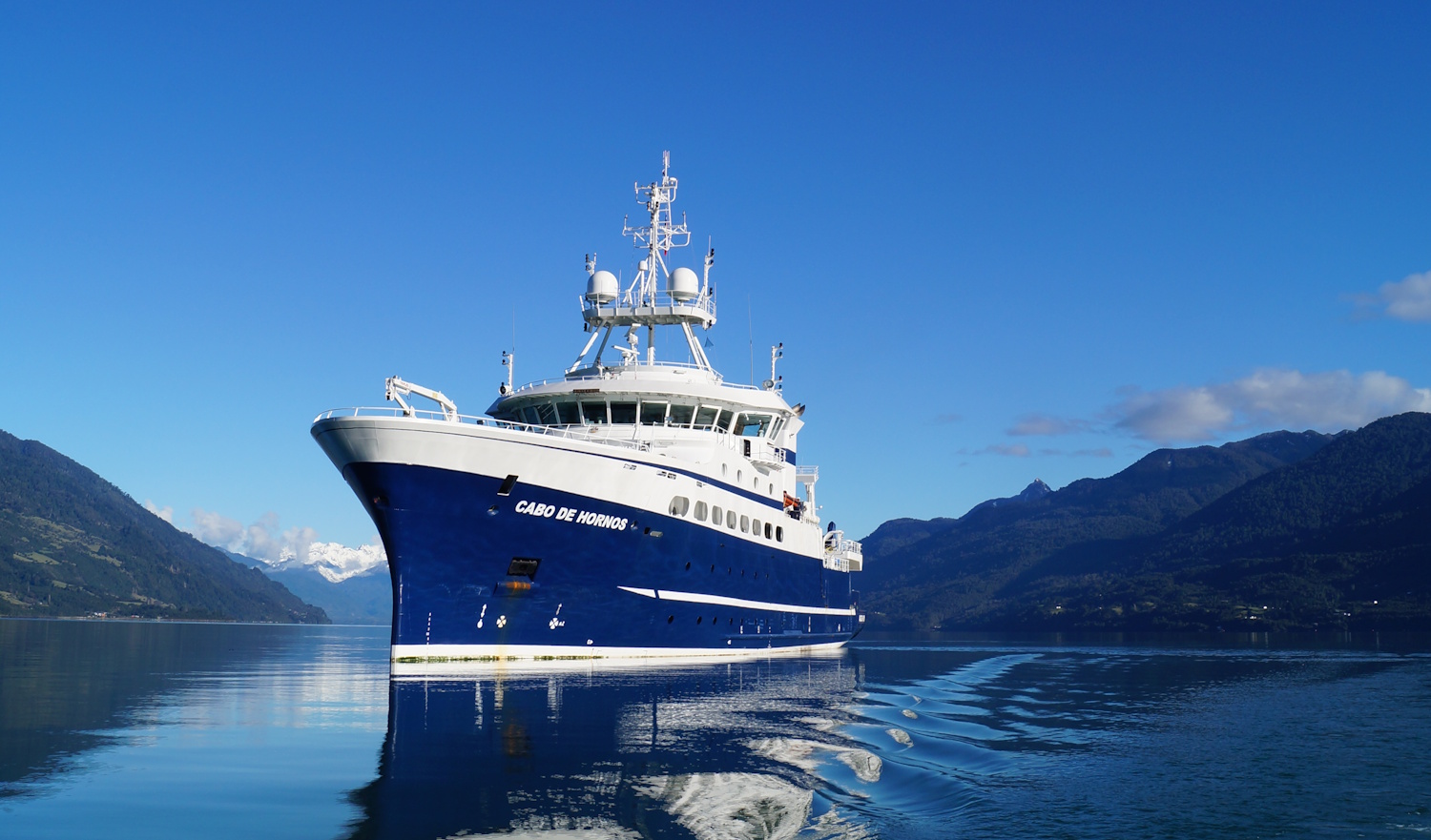
The expedition, funded by ANID and supported by the Chilean Navy, will reinstall the IDOOS observatory in the Atacama Trench and sonar-map areas of the seafloor off Taltal that have never been seen in high resolution.
A scientific expedition bringing together two parallel research projects will set sail this Monday, October 5, aboard the oceanographic vessel AGS-61 Cabo de Hornos, belonging to the Chilean Navy, heading toward the Atacama Trenchin the northern part of the country.
The voyage, which will run through October 27, is led by the Millennium Institute of Oceanography (IMO in spanish), the University of Concepción and the Pontifical Catholic University of Chile, in collaboration with the Millennium Nucleus for the Study of Oxygen Depletion in the South-East Pacific (DEOXS) and the Oceanographic Instrumentation Center (CIO in spanish). It was made possible through the awarding of ship time in the 2026 National Oceanographic Vessel Time Allocation Competition at the National Agency for Research and Development (ANID in spanish)..
For over three weeks, two research projects will operate simultaneously. One will focus on the deep ocean and the effects of El Niño, while the other will examine the seafloor geology off Taltal.
Two Parallel Research Lines
The principal investigator at IMO and professor at the University of Concepción, Dr. Rubén Escribano, explained that the main goal of the trip is "to reinstall the Integrated Deep Ocean Observation System (IDOOS) in the deepest part of the Atacama Trench", which has been successfully deployed on previous expeditions since its launch in 2023. As he detailed, this observatory "will gather real-time data on the physical, chemical, and biological conditions of the deep ocean".
"We are going to study the surface layers associated with the Atacama Trench to evaluate the impact of the El Niño phenomenon and how it will influence deep ocean dynamics", added Escribano, who is also a senior researcher at the DEOXS Millennium Nucleus.
In parallel, the geophysics team, led by IMO postdoctoral researcher, Dr. Valeria Cortés, will focus its research on the Atacama Trench off the coast of Taltal and the Mejillones Peninsula. This zone corresponds to a seismic gap—a segment where no major earthquakes have been recorded in a long time.
"We want to complement previous studies, which focused on deformation—how the seafloor moves and what shape it has—but we haven't obtained high-resolution studies of tectonic faults and landslides in the topmost layer of sediment covering the continent and the trench", Cortés explained.
The scientist also highlighted the unprecedented nature of the work: "There are areas, for example, that have never been seen in high resolution with sonar, and that is what we are going to do for the first time: illuminate them to understand them and incorporate them into our regional models".
The expedition also includes an educational component. For Cortés, this marks the first time she is leading a geophysics team, and the group decided to include a high percentage of students to "give them the experience of being aboard the ship and learning how geophysical data is collected and processed".
How to Follow the Expedition
During the voyage, IMO will share short videos on its social media platforms showing the work on board and will open a form for the public to submit questions to the scientific team. The answers will be compiled into a recap video to be published at the end of the cruise.
This milestone is executed by the Millennium Institute of Oceanography (IMO), the University of Concepción, and the Pontifical Catholic University of Chile, in collaboration with the Millennium Nucleus for the Study of Oxygen Depletion in the South-East Pacific (DEOXS) and the Oceanographic Instrumentation Center (CIO), with funding from the National Research and Development Agency (ANID) and support from the Chilean Navy via the oceanographic research vessel AGS-61 Cabo de Hornos.