
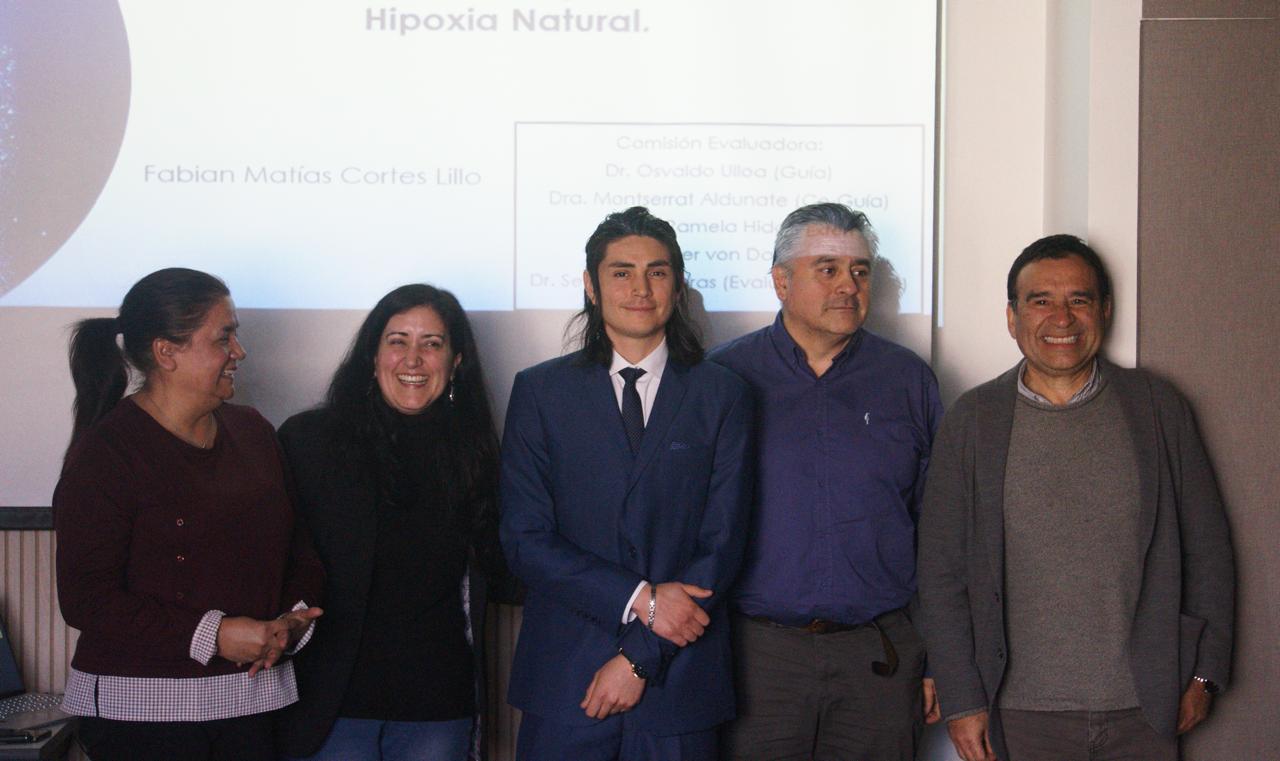
The master’s student defended his degree research in mid-August under the guidance of Dr. Osvaldo Ulloa and Dr. Montserrat Aldunate at the Millennium Institute of Oceanography (IMO).
On Wednesday, August 19, Master of Science in Oceanography student, Fabián Cortéssuccessfully passed his degree examination with the thesis titled "Response of the Surface Phytoplankton Community to Natural Hypoxia"-
The academic defense took place at the Faculty of Natural and Oceanographic Sciences at the University de Concepción (UdeC in spanish), under the auspices of the Millennium Institute of Oceanography (IMO in spanish).
Guided by Dr. Osvaldo Ulloa (Director of the IMO) and Dr. Montserrat Aldunate (DEOXS Early-Career Researcher), the study aimed to generate experimental evidence regarding the impact of naturally hypoxic conditions on surface phytoplankton. Cortés noted that the primary goal was "to provide experimental evidence on how naturally hypoxic conditions affect surface phytoplankton, specifically regarding their abundance, carbon fixation rates, and fluorescence".
Furthermore, the research investigated the potential role of oxygen in driving the chlorophyll minimum—a distribution pattern observed in certain marine regions near the base of the oxycline and above oxygen minimum zones.
Nuanced Findings
Cortés’s findings suggest that oxygen may represent one contributing factor to this spatial pattern, though he cautioned that “its effect is not uniform and varies depending on the specific phytoplankton group evaluated”.
Accordingly, the researcher emphasized that "the absence or low abundance of phytoplankton at these depths cannot be attributed to oxygen levels alone". Looking ahead, he underscored the need for further experiments that “simultaneously evaluate the combined effects of oxygen alongside other variables—such as light availability, nutrients, grazing pressure, and metabolic processes—to identify the precise mechanisms underlying the formation of the chlorophyll minimum".
Reflections on the Defense
For Cortés, the defense marked the culmination of a significant stage in his academic trajectory "I was quite nervous, but at the same time I felt prepared and confident in the work we had accomplished and the expertise I had gained throughout my thesis research".
Two moments stood out during the examination: the feedback from the evaluation committee, which he perceived as a genuine commitment to enriching his research, and a series of questions regarding metabolic pathways that pushed him beyond his comfort zone. "That experience was exceptionally valuable because it reminded me that, even after years of training, there are always areas where we can continue to learn and deepen our understanding", he added.
Dr. Montserrat Aldunate, who mentored Cortés throughout the project as co-advisor, highlighted his development: he had the opportunity to participate in research cruises, master specialized oceanographic techniques, and collaborate within demanding field environments. According to Dr. Aldunate, Cortés tackled "a highly complex and novel topic in the study of marine phytoplankton”, with perseverance and dedication.
The Role of the IMO
Cortés characterized the Millennium Institute of Oceanography (funded by ANID) as a pivotal environment for his academic growth, granting him access to collaborate with senior researchers and specialists in oceanography and experimental design.
Among the key assets of his tenure, he cited the scientific and technical mentorship of Dr. Osvaldo Ulloa, Dr. Aldunate, and their research team, alongside training opportunities through oceanographic cruises with multi-institutional teams. He also acknowledged the financial support provided by internal UdeC scholarships and a postgraduate fellowship from the DEOXS Millennium Nucleus, which enabled him to pursue his research on a full-time basis.